


It is the height of human hubris to think that we’re special or unique, but most of us are not. Your ego was just bruised. You will probably stop reading right here. If you are brave enough, you will continue to the very end if you want to reach a new level of understanding and how you can become the unique creature you think or perceive yourself to be, or the pecular being that God created you to be.
Can you break your programming and keep reading?
The first thing that you need to understand on the scale of human achievement, most of us are going to live very mundane and boring lives of little consequence. Beyond our immediate circumstances and circle of friends, we’re not going to have much influence on this world. The human mind is only capable of handling and interacting with about 150 people regularly in a given lifespan. In a world of 8.062 billion people, the number of people you can reasonably influence is a minuscule fraction.
The second thing we need to understand is that we believe many things that aren’t just true. Once we overcome these false beliefs then we can really start to make waves that reverberate beyond our sphere of influence. Here are some things that you need to unbelieve and unlearn.
Not all people are created equal. This is a fact. Some people are smarter. Some people are prettier. Some people’s personal circumstances, like social economic advantages like being born into a wealthy family, give them an edge in life that others simply will not have. It is an eternal constant. Accept it. Deal with it. Move on. As much as we try to create equal opportunity in America it is an ideal we still fall short of even though we keep trying.
Not all people are unique or special. We may have distinct features and personalities but in general Western society we are pretty much the same. Christianity promotes the idea that we’re all different in the eyes of God. Verses like Psalm 139:14, which speaks of being "fearfully and wonderfully made," and 1 Corinthians 12:12-27, which describes the diversity within the body of Christ, support this concept. But just because you are different doesn’t make you unique. Both "unique" and "different" relate to distinctions, but unique implies being one-of-a-kind, without equal, while different simply means not the same as something else, with degrees of difference possible. When you get down to it, other than slight differences, we are all the same.
In the Western world, we are the same because we’re uniquely programmed to be the same. How so, you wonder? We have norms and values that are communicated from parents to children. We have standards and laws that are passed down from government to society. In the West, we are a people ruled by law, some written and some unwritten. In many ways this is why democracy and western civilizations thrive and others do not. People working together within a framework that allows for safety, civility and progress. Its the American way, the American dream. God bless America.
But this programming also lends itself to stagnation and producing mundanity. If you will allow yourself to be unplugged from the Matrix for a few minutes, think about how many times your life seems to be predictable. Think about how much of your personal interactions are quite literally programed, even scripted. Here is an example.
“Hello.”
“Hi, how are you today?”
“I am good. Thank you. How are you?”
“I am fine. Thank you for asking. What can I do for you today?”
You can hear this conversation in your head without even trying. You probably had it with someone today. You had this conversation with someone without even thinking about what you were going to say. The words were there and came involuntarily, just as they have been programmed in your mind to say. Those words were spoken without thinking, without feeling and without any effort. It was stimuli and response. This conversation is the metaphor of our lives.
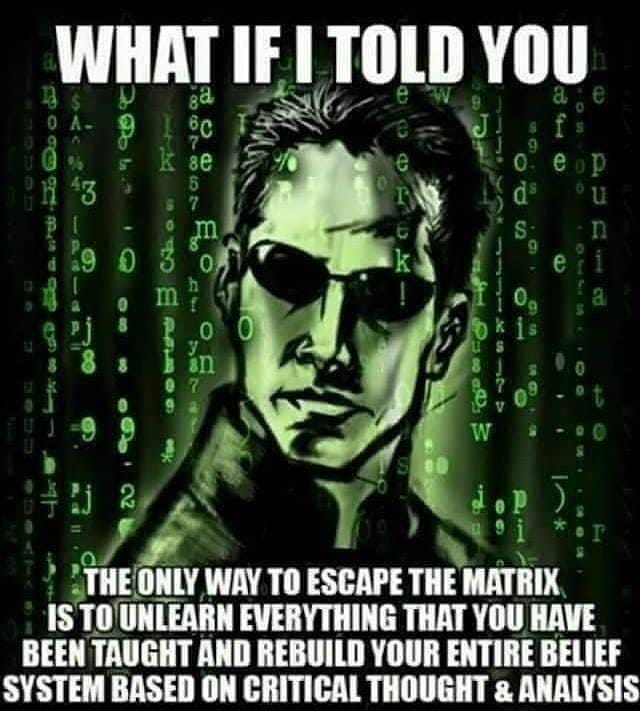
If you want to be even more depressed about your mere commonness, take this example and realize that you are just a mini biological chat bot. We’re just biological entities moving around on this oxygen covered sphere interacting with other biological entities performing our programmed functions. Nothing more or nothing less. This is the easiest and most recognizable example of our programming. In essence, humans are performing a LLM function or large language model.
In the world of artificial intelligence, teaching a program how to respond to human language stimuli is key to success in the field and developing an AGI (artificial general intelligence). If you aren’t familiar with the term, an LLM is a type of AI model, specifically a statistical language model, trained on massive amounts of data to understand, generate, and translate human language. If you are typing in Google or a word processing program, you see the “predictive text” that pops up before you finish the sentence. That is the program working on its LLM to determine what you are going to say.
In many ways, this is us with most of our interactions. This concept came to my attention watching the Diary of a CEO podcast with one of my favorite physicists. Skip 30 minutes in and start listening to the conversation with Eric Weinstein.
The point is if you want to be unique and or special in this life, you need to be able to identify your programming and start breaking it down by disrupting it.
Start with the basics like regular human conversations. Disrupt your interactions with non-programmed questions and responses. You will find that your interactions with people will become more real or even more memorable if you force them out of their own programming. They will certainly remember you and your “weird” conversation.
Be unpredicatable. There is nothing wrong with being anomalous. Those are the types of people that change the world. Those are the types of people we remember. Those people are who change the world.
For example, take a look at the life of Jimi Hendrix. He wasn’t just a talented guitarist, but rather he did things with his instrument and equipment that others weren’t doing to generate different results. His use of “feedback” from the amps allowed him to get greater sustained notes in his performance. He innovated different recording techniques, many of which are still being copied today. Jimi Hendrix inspired other innovators in music like Eddie VanHalen and Steve Vai who took the genre instrumentally to another level.
If you want to look at someone more modern, look at Elon Musk. He is a major disruptor in the world of science and technology. What made Elon unique was the fact he questioned the dogma that rockets couldn’t be reuseable, which was a major expense in the space program. He disrupted the common thinking and approach to space science and made not only a name for himself, but one of his three unique billion-dollar companies. He continues to disrupt multiple sectors of science generating innovation. He is also making waves in social and political arenas which is an outcome we’ve yet to see come to fruition.
Being a disruptor comes with consequences. There are people that will criticize you and some will try to counsel you with good intent not to “rock the boat.” People who go along to get along never change the world. Those people are never a threat either. There is so much truth found in these lines from “The Matrix”.
"The Matrix is a system, Neo. That system is our enemy. But when you're inside, you look around, what do you see? Businessmen, teachers, lawyers, carpenters. The very minds of the people we are trying to save. But until we do, these people are still a part of that system and that makes them our enemy. You have to understand, most of these people are not ready to be unplugged. And many of them are so inured, so hopelessly dependent on the system, that they will fight to protect it". Morpheus - The Matrix
Realize that there are people who are dependent on the system and desire nothing more for you than to be a good little biological bot performing your basic programming. There are people who are depending on the system for their own self-fulfillment and power needs. Some of them have based their entire lives and careers around it.
A great example is the world of archaeology, particularly when it comes to Egyptology. Graham Hancock advocates for the existence of a lost, technologically advanced global civilization that was wiped out during the Younger Dryas period (around 12,800 years ago) by a catastrophic event, possibly a comet strike. He claims survivors of this civilization then spread their knowledge and technology, influencing the development of later cultures like those of ancient Egypt and Mesoamerica. Whether he is right in his assertions or wrong, the crux is if he is correct, then all the people in academia’s PHD’s and papers and writing become utterly false. Their diplomas and papers are untterly recycleable at that point.
The fact that he is merely pointing to evidence (which is highly debated) has caused such as stir that the attacks have gone past his assertions to him personally. You know when your work has struck a nerve or potentially has credence when they skip over that and label you as a white supremacist, even though you have a wife that is black. When you are attacking the person instead of what they’re saying shows a clear panic that they might be right and your world is coming down.
The consequences of a disruptor who shakes the foundations of belief seldom finds his or her self as the sole object of their condemnation. In Japan, there is a saying that “the nail that sticks up gets hammered down.” If you are willing to stand up and or speak up, do you have the constitution to resist being hammered down?
Most people want to live their lives quietly full of as much pleasure they can get and minimized conflict. These people too don’t change world either. Being a drone does have its benefits too. But as a farmer, most of the times my imagination gets the best of me, and often wonders if the cattle that are in my pasture truly knew what the fate of their offspring was and ultimately them, would they be standing so calmly within my barbed wire fence?
Those of us who get up in the morning and go to work, put in our eight hours, and go back home and repeat the cycle five time per week, fifty-weeks a year, are we any different? As long as there is grass in the pasture, food on the table so to speak, and a safe place to dwell, why would we buck the system? From Martin Luther to Martin Luther King, societies are transformed by those who are willing to bear the cross for the sake of change and disruption.
Life, liberty and the pursuit of happiness, right? Life we understand. The pursuit of happiness we sort of understand but today there comes with it a sense of entitlement our founding fathers didn’t intend. But liberty we have no clue. We think we know what it means. Liberty is the state of being free from external constraints or coercion. Now AI will add that liberty encompasses the freedom to act, speak, and think as one chooses, within the bounds of the law and without infringing on the rights of others. What AI won’t extrapolate is that you are being coerced whether you realize it or not through norms and programmed behaviors.
You are coerced by news, television “programming”, social media and even religion. You are surrounded by screens and advertisements trying to coerce you, to stimulate you to do something. In a world of screens, responsibilities, schedules and obligations, no one is free from coercion.
One of my favorite “rock star” stories is about Glenn Buxton, guitarist for the original Alice Cooper band. G.B. was known for being a true nonconformist. There is a story that is told about him randomly giving people birthday gifts throughout the year not on their birthday. His thinking was why should you give someone you love a gift on a calendar just because it’s the date. He refused to allow his actions to be dictated by anything, even a calendar. To us it is a date with significance. To him it was a boundary or requirement. His need to be free from the norm to love people how he wanted to love makes him someone in rock n’ roll still talk about today, not just for his unique guitar playing but his unique behavior and need to be free.
Can we all be Elon Musks? Can we all be Jimi Hendrix or Glenn Buxton? In theory we could. Should we? Probably. As much as we think we’re leaders, in reality, we’re all followers. We do what is expected of us and we do it. We’re content with the limited freedom given us within our boundaries and accept it.
What would happen to society if we were disruptors? Is true freedom chaos? Is true liberty anarchy? I don’t think so, because so few choose to go that route. But there needs to be more of because in our time people like Elon Musk are too few. The need for more disruptors in our time is so apparent.
“It's weird not to be weird.” John Lennon
“Any fool can make a rule and any fool will mind it.” Henry David Thoreau
“Conformity is the jailer of freedom and the enemy of growth.” John F. Kennedy
“If you are always trying to be normal, you will never know how amazing you can be.” Maya Angelou
“No shepherd and one herd! Everybody wants the same, everybody is the same: whoever feels different goes voluntarily into a madhouse.” Friedrich Nietzsche
Depending on how you want to be remembered and what legacy you want to leave behind, you will need to decide how disruptive you want to be. If you want to do big things, you must be willing to be disruptive with the small things too. It takes many little steps to arrive at the destination of your journey. I would like to think by you reading this article, I have caused another disruption in system by getting you to think about your own programming. Of course, I could be wrong about all of it, but its just my perspective from the bottom end.
#humanbehavior #llm #agi #mindcontrol #disruptors #thematrix
Hi there, I love it. I write literary fiction that blurs the line between the occult and the everyday—urban hermits, haunted architecture, the metaphysics of solitude. Each story explores invisible living, temporary autonomous zones, and the magic hidden in forgotten rooms. If you’ve ever read Hakim Bey, walked an empty hallway and felt watched, or wondered how to live off-grid inside the grid—this is for you.