


Twenty plus years ago it would have been very helpful and kind for someone to explain to me as a young independent artist what I am about to purport to you. Making it in the music industry is equivalent to winning the lottery statistically. In an industry that has no compassion or soul and with little money pouring through it because of streaming and the internet, being in the music industry is not ideal. But if you love songwriting and performing music with no delusions of grandeur, you can make a living at it or you can enjoy it amateur or semi-professional levels.
The unknown and ugly reality that many independent artists need to realize (the sooner the better) is that everything in the beginning is going to cost you money out of your own pocket. Even after you get to a paid professional level it’s still going to cost you money out of your own pocket just on a grander scale. Here is some basic information, tips and advice from someone who has had to learn the hard way and from trial and error. Invest 20 minutes of your life and read this because it is my gift to you from one independent musician to another.
Reality Check
Many people are under the illusion that record labels are walking around handing out checks with free money to talented artists. A record deal isn’t free money. It’s a loan with interest much like a mortgage. Advances from the label are loans. You, the artist, are on the hook to pay them all that money back. There is a plethora of books you can read about this but have no illusions about what a record deal is really. Anything the record label pays for directly; you have to pay back with interest. A record label is a bank that loans money to artists who they think can turn a profit. That is the music business and industry in a nutshell.
The reality is that most labels (independent or the big three) aren’t going to be interested in you as an artist until you are making money on your own regardless of your talent. This is not the good old days where labels had money to invest and grow artists. Those days have passed. Physical sales are what drove that model. If you read the biographies of most rock bands, most of those artists were selling albums independently before they were picked up by a label. The biggest advantage of a label is that they do have the power to make you big. But everything it invests in comes with a price. And on top of that, you probably won’t even own your masters. Today only 2% of people who are in the music industry make money solely from their music. The rest have alternate revenue streams to keep them in business or to maintain their lifestyle. That unfortunately is a fact that the industry doesn’t like upcoming artists to know.
If you or your bandmates have wives, lives, kids and mortgages, you really need to make sure you are grounded in reality. Unless your spouse is the main breadwinner for your family, it is nearly impossible to make a living wage in music based selling your own music. You can’t halfway commit to making it in the music industry. You can’t have a plan b. You must fully commit to going all the way, because you will never be able to take a big risk when opportunity calls. Stay single and out of debt unless you and your spouse are committed to you making it a full-time endeavor. Even being an independent musician is still a full-time job. You must put in the hours to make things happen, but we’ll expound more on that later.
Branding & Product
Many artists don’t like to refer to themselves as a brand and their music as a product. Get over yourself. It is the music business. It’s show business. It’s the entertainment industry. This is a business. That is how you and your music is going to be treated. If you want to make music and money, you are going need to treat it as such. Educate yourself and understand how trademarks and copyrights and royalties work because those are revenue streams you will need. You are selling something. Initially it’s yourself and or your brand. Then next it’s the music. It’s a job and you’re making a product that you hope people will want to purchase or pay for the service of seeing you perform. Once you come to terms with that you can proceed and succeed.
Return on Investment
Unless you are one of those rare exceptions, you are going to have to learn to be business savvy to make it with or without a label if you want to make music for a living. Learn now to invest your money wisely. A phrase that is big in business that you need become acquainted with is “Return on Investment” otherwise known as ROI. Whatever you invest your time and money in you need to make sure you are getting a sizeable return. Whether its for product or services, know what you are purchasing and how much you are going to gain from it.
E.g. if you buy a t-shirt for $5.00 sell it for $15.00 each. A $10.00 retail is 50% margin and $15.00 is 100% margin. You need to make at least 100% margin. Not only do you have to pay for the cost of the shirt you sold but you need to make enough money to replace it and reinvest for the next as well as turn a profit. Also remember, perception is key. In the consumers’ eyes low price denotes low quality so don’t be afraid to put a high price. Offer a “deal” to customers occasionally when you need cashflow. But make your merchandise cool. Just don’t slap a logo on it and call it done. Make it worth buying independent of your own music. It’s a product that will fuel your music, not vice versa. Often my band has joked that we’re really a t-shirt company that goes around playing music.
About doing shows, those are investments as well to consider ROI. Lots of venues, festivals and promoters love to say “its great exposure” with no commitment to pay you. Usually, local gigs with no real out of pocket expenses are no brainers, but if you are being asked to perform at a great distance with expenses out of your own pocket there are many things to consider. Just for example, let’s just say it’s a festival. Is the genre of music festival like your own style? Is the audience demographic those you are wanting to target? Will you be able to sell merchandise and they’re providing a space and staff to help you sell it while performing? Can you sell enough merchandise to cover the expense and make money? You must weigh all this out in your head to make that determination. Live performances are an investment of time and money that you need to make a profit in either merchandise sales or growing a fan base for future sales. More will be discussed on this subject in this regard later.
Judging the book by its cover
Another investment or connection you need to make is with a graphic artist/designer unless you have a band member who is skilled and can execute your brand and marketing vision to the fullest. Make the time to sketch out your ideas on paper and communicate clearly in writing your vision for your brand. Be sure this person is someone that you communicate well with and understands your vision. Never settle for less than what you want, but remember you get what you pay for in the end. Like musicians, artists are sensitive people too, so be tactful. Don’t be afraid to shop around and haggle with artists. Instead of paying them a one-time fee for the work, offer them a percentage of the sales up to a predetermined dollar amount; t-shirts, CDs, posters, etc. If they agree to a percentage, make sure it’s in writing, define when they get paid (monthly, quarterly), follow through with the payments and keep the receipts. Make sure you own your artwork in writing! Even professional level artists like the band TOOL have made this mistake. Google it, read about it and learn from it.
A good photographer is another important investment. As previously mentioned about graphic artists, the same applies with photographers. The importance of a good photograph cannot be understated. The first impression of you comes from your branding and your photography long before your music gets heard and critiqued. The quality of your packaging many times will determine if your music will even get heard. This is a confession of many industry professionals. It’s shallow but that is the business. But then again, how many products have you bought off the shelf that had crappy packaging? The same applies here.
If your band photo is just a picture of taken by friend in your backyard or heaven forbid, the awful railroad track shot (every band ashamedly admits to having a railroad track shot) your EPK or whatever its going into a pile never to be seen again. Your live shots do not be from the back of the venue with a huge empty space between them. Make sure whoever is taking your photos is getting as much of the crowd in the photo. If it’s a sparse audience, the stage closeup shots are better. No promoter wants to see you playing in an empty venue. This was said to me directly by a promoter. He mentioned how many bands do this without thinking about it. Be mindful of your photos and what they show, especially on social media.
As much as you invest in the quality of your music, invest in the quality of your photos and branding. It’s a package deal whether you like it or not. You can write the best song ever written, but if it is not presented in the best way, it will never be heard. Accept it. Embrace it and move on to the next thing to worry about.
Hiring the Right People
Depending on where you are in your development process there are other key investments that you need to make: a lawyer, a publicist, a booking agent and maybe a manager if you get big enough. These are what I call necessary evils. But if you understand their role and how and when to hire their services, you will navigate this industry better. Get references and referrals then decide who you are hiring.
Find an industry lawyer that you can trust and engage their services when needed. When in doubt, talk to a lawyer. Anytime you have a contract you need to sign, if you don’t understand any part of the contract, ask a lawyer. If you have a performance contract and fail to make the gig you may owe them money. Remember, this is a business. If they spend money advertising you are going to be there and don’t show, you cost them money. Make sure you have outs in your contracts for contingencies or the unexpected like deaths in the family, illnesses or whatever. Lawyers are good about adding fine print and you want to have one of your own to protect you.
A publicist can help drive listeners and industry professionals to your music by using their connections in the media. You only need a publicist when you have something to promote. Unless you plan on developing a contact list of every magazine, radio, and entertainment source within your genre, it’s best to leave this in the hands of the professionals. Odds are they already have the relationships with these people to get your message out to the audience you want. Most publicists will have package plans with pricing. Look at the plans and discuss it with your publicist. Don’t forget ROI. Make sure that you are getting the results you want from the publicist’s services. You should be growing brand awareness, more sales, more listeners and ultimately more money for you to reinvest into your music. After every campaign you should do an evaluation of its effectiveness. A good publicist will have a report to show you after it’s all said and done.
A failing in most businesses is a lack of planning to advertise. You may have the best product or service in your market. If the market doesn’t know you have it, how will they know it is there? The same goes for your music. Just getting your single, EP or album in distribution with Tunecore or Distrokid through all the media outlets isn’t enough. Your publicist should be able to help you determine where to invest your money in advertising.
It is almost a joke amongst artists regarding booking agents and they are an interesting group of professionals. Many promise they can get you shows and many opportunities but those are just words. Booking shows is highly competitive, especially on the festival circuit. Many of the bigger festivals you must be on a label just to get a shot. You really need to be able to know how large of a crowd you can draw. If you are new to the area and or state, the promoter is going to look at your social media presence, your EPK and make that determination regardless of what the booking agent says. Never ever, under any circumstances pay a monthly rate for a booking agent as an independent artist. Insist on pay per gig basis. If you need $500 to make a performance meet your ROI, make them tack their fee on above your needs to make it happen. You don’t need to lose money so they can make money. You are doing all the work and they’re getting a cut. Also, make sure you are blind copied on all emails. There are horror stories by the thousands about independent artists who signed contracts with booking agents who insisted on being paid monthly who never got gigs and still had to pay them.
Lastly you need to invest in a manager once you get to a certain point. Having a manager is a tricky thing depending on how you work the contract. The average percentage for a manager ranges from 15% to 30% of the gross profit typically. If you don’t understand Gross profit verses Net profit you need to grasp that first. Using simple numbers, let’s say the band brings in $100 Gross. If your manager gets 20% gross, then he gets $20, even if the cost of making the $100 is $50. Simply $100 Gross minus $50 (show cost) minus (Managers Fee/Commission) $20 you’ve made $30 Net. Now you split $30 however many ways with your band members. If you have 5 band members, you pocket $5 each. But wait, there’s more – that doesn’t include taxes. Your management walks away making more money than you!
Classically this is where bands/artists get taken for a great deal of money. It may seem unfair, but this is the nature of the beast. A good read of how a band got screwed by its manager is Aerosmith. Just Google it and you can read all about it. It’s a classic example in the industry. Learn to manage yourself if you can honestly depending on what your goals are.
Make sure you negotiate wisely with your manager and define their role and responsibilities in writing. Paul Stanley, co-founder of Kiss, said in his book Face the Music, if you don’t think you’re getting screwed by your accountant or management, you just haven’t figured it out yet. Have people who can audit your books and contracts. Let them know you plan on things being audited and watch the shady people scatter like cockroaches. Invest the time to learn what a contract needs like a “sunset” clause and make sure your contract has one.
Go small to go big
The reality is you don’t need a record label anymore. You can be on iTunes, Spotify, Amazon Music, wherever without a label. It’s really the only benefit the internet gave the independent artists by taking down the gatekeepers. But that also means you are competing with the world in your genre. Just saying you are a rock band, or a country artist isn’t going to cut through all the noise. Developing a niche music style is the way to go. Try to create your own genre if you can so you can hashtag it to death on social media to help establish your brand. Before you sign up for CD Baby, Tunecore, Distrokid or whatever service you are going to use to launch on those platforms, make sure you have a plan on how you’re going to market yourself in a world market. The more niche you are the better.
Know Your Worth
Many musicians come into this industry so desperate to make it big, they don’t realize how much of themselves, their music, their rights and their money they give away just to achieve what they perceive as success. Your brand, your music and integrity are the most valuable things you possess. Don’t give those things away for nothing to achieve a status that is not good business. Remember, only 2% of musicians make money from just their music and making it big is like winning the lottery. You must define what you consider is successful for yourself.
If you want to make a living by playing music in general, it’s certainly possible under certain circumstances. Where I have seen this work is under two scenarios. You will play many nights a week in different groups and venues, probably playing someone else’s music (probably covers) to a crowd of people who aren’t your fans. But if it’s a paying gig, it is a living.
If you want to make a living by playing your own music that is much harder to achieve. Not only do you have to be a musician and songwriter, but you also have to be a paralegal, graphic designer, copy writer, publicist, social media manager, booking agent, band manager and accountant. If you are a solo artist, all of that is on you. If you are in a band situation, you can spread all those responsibilities around to other members. But in my experience, one or two band members do all the work, one may do some though typically the bare minimum, and one or two do nothing at all. It’s the classic 80/20 rule.
Speaking of band members, there are things that can kill a band quickly like egos, laziness, negativity and self-deception. It’s a lot easier to pull a wagon if all four horses and moving in the same direction. If you have someone in the band that isn’t pulling their weight or is always being contrary of negative about what you’re trying to achieve, get rid of them as soon as possible. Even if they are the best musicians in your town, you don’t need that baggage and it’s just going to frustrate you down the road. Over the years its proven to me that amiability, reliability and cooperation in a musical partner has gotten me farther than tolerating the best talented musicians. You have value too if you are doing all or most of the work. Talent doesn’t guarantee success. Hard work, consistency, loyalty, dependability and perseverance are what makes you successful in spite of it being a cold and soulless industry.
As far as the monetary value as an artist, you will have to determine as you go. The bigger the crowd you can draw, the more you can ask. If you are just starting out, make sure you aren’t being paid with “exposure” because someone is making money on you as artist somewhere in the scheme of things. Whether it be a cover charge at the door or the food and or alcohol sales in the venue, money is being made. Value yourself and ask for your cut. Good promoters and or venues will tell you upfront what part of the door and the house sales yours is typically. If they don’t, ask. If you don’t do that, just say no. They may not know what is standard for artists, even independent musicians. Make sure you work this out before you show up for the gig. Tell them you must at least be able to cover your expenses even if it’s just gas money to drive across town. Get something or don’t play. If you just want to play, let them know the first one is free but after that they have to pay.
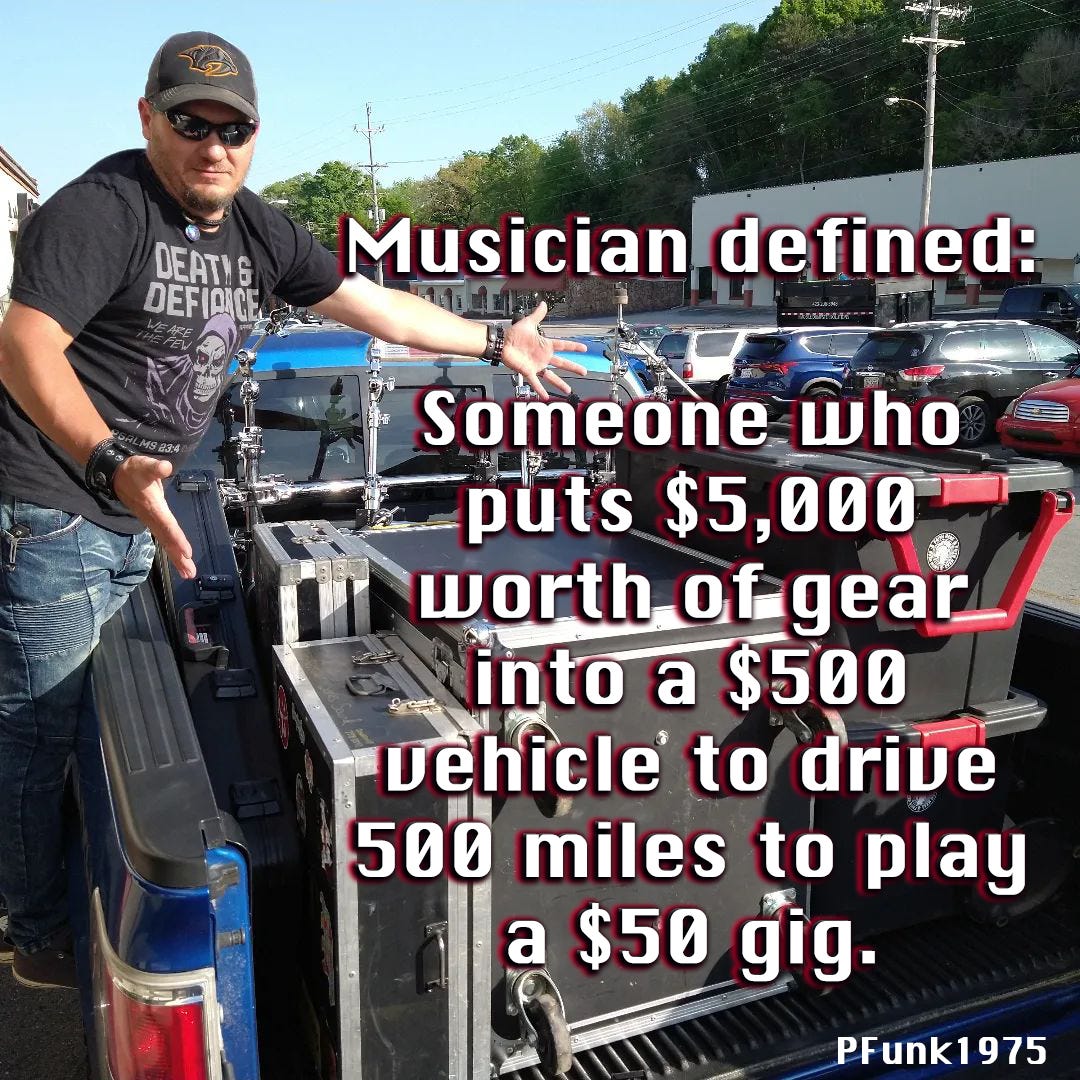
It’s okay to say no. Usually that is the job of the manager or the booking agent, but if you don’t have one of those just be honest and lay out the facts. It’s going to cost me X amount of dollars just to show up and get back home. If they say you can make that up in merchandise sales, ask for a guarantee in writing on that. Remember ROI again. That merchandise costs money. If you spend it traveling to and from a gig, then you won’t have the money to replace it. If they can’t afford your services, then it’s just an issue of economics. Nothing personal. Ask them if they like to do business at a loss. It’s just business.
Know Your Fans Worth
Investing in your fans is also very important. If someone spent their time and money to come see you, they are worth your time to greet and say thanks. On the front end, you are going to play to a lot of empty rooms before people start to show up to just see you. Walk up to them and thank them for being there. Ask them their name and tell them you appreciated that they watched your performance. Insert your favorite cliché here but its very true kindness and appreciation goes a long way. Don’t wait for your potential fans to find you or come to you in the merch booth. If they come into your booth and buy some merch, make sure you have a little inexpensive item to give them for free as an extra, like a sticker or wristband. It’s an investment in them in hopes that they will come see your next performance and buy your next piece of merchandise.
As you grow your fan base, identify key “super fans”. A super fan is a person constantly sharing your posts, liking, commenting, etc. These people are invaluable. Identify these people in key cities and states and invest in those relationships. Send them a free t-shirt, poster, whatever. They will turn more people on to your music and help build your following. You may turn fans into friends that may need in the future.
In my experience, fans on social media are fickle at best. If you want to focus on feeding the beast, feel free to do so. A Like is not equivalent to a dollar. If you can figure out how to turn likes and shares into dollars please contact me. Don’t buy followers, streams or anything else of that nature. People like me who study and track that information can tell right away who is faking it just to make themselves look bigger than they are. Don’t waste your time and money. Build organic followers and most importantly, start an email mailing list. That is how you build and stay in touch with a fan base. Social media platforms come and go. Mailing lists are yours forever.
A few things to keep in mind
Everyone talks in the industry. Booking agents, promoters, managers, publicists, roadies, producers and especially other artists and whoever you can think of – they all talk to one another. Their circles overlap in different ways. Watch what you say and to whom you say it but most importantly listen. There are many personal stories that could be included as anecdotes here, but you should get the picture. Always say nice and professional things to those you meet and especially those you don’t know.
Reputation in the industry is everything. You want a reputation of being a professional. Show up on time, be kind and courteous to everyone. It is a faux pa to cancel a show but sometimes is happens but if it does happen, make sure its for a legitimate reason.
Remember, it’s a business and its about money. If you are looking to get signed, you need to learn about all the types of record deals. Don’t ever do a 360 deal. No artist I have ever known had one said it was good. Being ignorant in this industry is a guarantee to get eaten alive.
If you really want to tap into this industry, you need to move where the industry is. If you are in a small town in the middle of nowhere thinking you are going to hit it big just playing your local venues, good luck with that. Los Angeles, Atlanta, New York, Chicago and Seattle are where you need to be. Depending on your genre, there are other options subject on how you want to make your money. The primary means of making money for a musician is session work and gigs. Position yourself where you can get yourself seen and heard to find work.
https://rentberry.com/blog/cities-for-musicians
If you are a band or two or more persons writing and making music together, you need to have a band agreement. Having a band agreement saves a time, discussions and arguments about how business is handled. YouTube is replete with videos on this subject. Below is a great video from an industry professional about it. Invest the time and watch.
Of course, this is all just my opinion from years of doing this playing on the periphery of the music industry as an independent artist. Most of it I’ve learned from personal experience. Some of it I’ve learned from others and their trials and errors. Much time and money has been wasted in my efforts to make a semi-professional career. I could be wrong about all of it, but it’s just my perspective from the bottom end.